跳至主要内容

Do you know the Diffusion Principle of the Diffusion Sheet?

As a Lighting Diffuser Supplier, share with you. Then let's analyze the diffusion principle of the diffuser plate. In fact, there have been some simple analyses on the diffusion principle of the light diffuser plate. Of course, there are still some differences between the two.
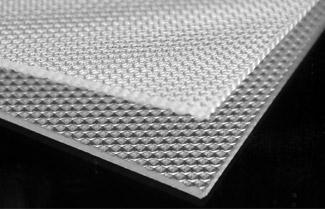
UGR <19
UGR <19 
Then to understand the diffusion principle of the diffuser plate, you must first know two principles, one is the reflection principle and the other is the refraction principle. Then the principle of reflection is: when light strikes a smooth interface from another medium, part of the light is reflected by the interface, and another part of the light is refracted through the interface in another medium. The angle of incidence of light is equal to the angle of reflection, and the reflected light is on both sides of the normal in the same plane as the incident light. The principle of refraction is that the refracted light lies in the plane of the incident light and the normal, the refracted light and the incident light are on both sides of the normal, and the ratio of the sine of the incident angle and the refracted angle is a constant.
Then the principle of Side Lighting Diffuser Sheet is through chemical or physical means, when the light encounters two media with different refractive indexes on the way, the physical phenomena of refraction, reflection and scattering occur, through PMMA, PC, PS, Adding inorganic or organic light diffusing agents to the base of PP and other substrates, or artificially adjusting the light through the array of micro-features on the surface of the substrate, causing the light to be refracted, reflected, and scattered in different directions, thereby changing the path of light. To achieve sufficient dispersion of incident light to produce the effect of optical diffusion, light diffusion plates are widely used in liquid crystal display, LED lighting and imaging display systems.
The diffusion plate mainly causes great interference to the light, no matter how many degrees the light distribution curve of the original design is, as long as the light passes through the diffusion plate, it will change the beam angle to 160 ~ 176 °, so from the side, the board of the lamp There is a feeling of fog on the surface. From this point, it can be proved that the beam angle is as large as 160 ~ 176 °. It is strong proof that the larger the beam angle, the lower the illuminance, and some will also produce filtering, making some wavelengths unable to penetrate, resulting in Color shift, such as light interference treatment again on the surface, the light transmittance is lower due to the natural phenomenon of geometric optics, so the base material used to make the diffuser plate should be selected as low as possible, the interference of light will be Lower.
Our company still has UGR <19 for sale, please contact us.

评论

此博客中的热门博文

Plastic Artist-Acrylic Processing Technology

Acrylic can be used casting, injection molding, extrusion, thermoforming, laser engraving, laser cutting and other processes. Casting molding Casting molding for forming plexiglass sheet, bar and other profiles, that is, body-bulk polymerization method of forming profiles. After casting molded products need to be post-processed, post-processing conditions are incubated at 60 ℃ 2 hours, 120 ℃ for 2 hours. Injection molding Injection molding using suspension polymerization obtained pellets, molding in the ordinary plunger or screw injection molding machine. Process parameters include screw injection molding machine, plunger injection molding machine, barrel temperature, injection molding products also need to eliminate the internal stress treatment, processing in the hot air circulation oven at 70 ~ 80 ℃, processing time as the thickness of acrylic products, the general All about 4 hours. Thermoforming Thermoforming is the process of making plexiglass sheets or she...

Is Acrylic Suitable for Lights?

When decorating a room, in addition to some decoration materials, you also need to install lamps and lanterns. Because lamps and lanterns are very important in people's life and can provide lighting. In the dark night, you can work and live as in the daytime. In recent years, acrylic lamps are especially popular. There are many types of acrylic lamps, and people may not know how to choose when they are choosing. In this blog post, I will give you details on how to choose acrylic lights and what to look for when installing acrylic lights .   The advantages of acrylic lights Color The color is very durable. Acrylic panels are glossy, bright and colorful, and the colors are durable for 5-8 years. In other words, it will not change or fade in 5-8 years. Transparent High light transmission. Transparent  acrylic sheets  provide over 90% light transmission. The built-in light source provides uniform and soft nighttime brightness. Compared to neon, acrylic letters as a whole are ...

Types of Acrylic Sheet

Acrylic - which also goes by the brand names of Plexiglas, Lucite, Acrylite and Perspex - is known throughout the world of plastics for its dazzling glossiness and its remarkable scratch and impact resistance. It even boasts a greater load bearing capacity than polycarbonate, one of the toughest materials out there. What you may not know is that this exceptional plastic comes in a variety of models designed to meet the specific needs of demanding owners and remodelers. If you've got a specialized project in mind and are looking for the perfect material to fulfill your design, read on to discover the variety of acrylic sheet   that'll help bring that design to life. Clear Acrylic Sheeting The most common form of acrylic, the flexibility of clear sheeting is evidenced mainly by the staggering variety of dimensions it can be ordered in. Thicknesses range from four inches to a 1/25th of an inch; widths from three feet to ten feet; lengths from four feet to twelve and a half feet. N...